
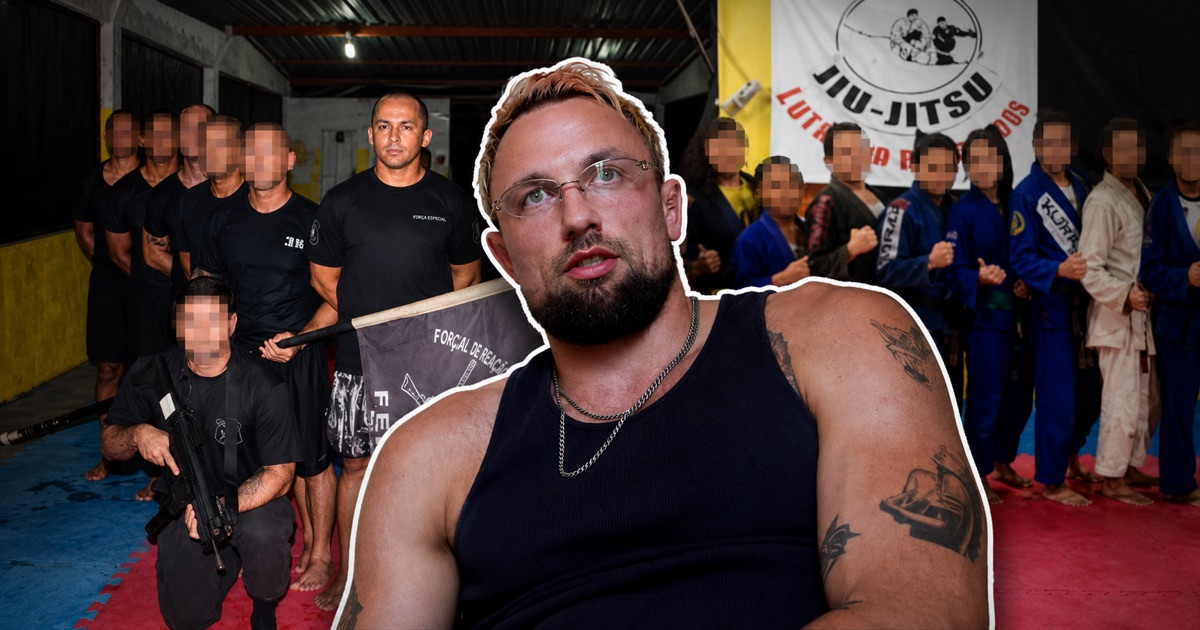
Video thumbnail: The B-Team. Used with permission.
Craig Jones published an 18-minute investigation on July 30 into a man who has been in prison since April. The B-Team film accuses Melqui Galvão, the celebrated Brazilian jiu-jitsu coach and Manaus civil police investigator, of shooting an unarmed man dead in front of his family in 2011. It also links him to the 2007 murder of his first wife, a case in which no one has ever been charged.
Galvão already faces charges of sexually abusing children in the free youth program that made his name. Nine women have filed police reports. The film argues those charges are one part of a much longer record.
Everything below is an allegation. Galvão has not been convicted of anything. His first instruction hearing is scheduled for October 20, 2026, and the film says so itself: "Nothing here is a finding of guilt by a court."
Why is Melqui Galvão in prison?
A São Paulo court issued a temporary arrest warrant for Melquisedeque de Lima Galvão Ferreira on April 23, 2026. He surrendered in Manaus, and preventive detention followed on April 28. Brazilian prosecutors charged him under four articles of the penal code: rape of a vulnerable person, sexual importunation, criminal threat, and unauthorized access to an electronic device.
The trigger was a competition trip to Rome in February 2026. A 17-year-old athlete on his team reported that he touched her while she slept in a car. Her family gave investigators messages and an audio recording. Brazil's SBT aired portions of that audio, in which a voice attributed to Galvão apologizes for his behavior and, according to the broadcast, offers things in exchange for silence.
What followed widened fast:
- By June 1, 2026, nine women had filed formal complaints. The youngest to speak publicly says the abuse began when she was 12.
- The IBJJF and CBJJ permanently banned him from both organizations and every event they sanction, calling the alleged conduct a violation of "the most fundamental ethical principles."
- He was transferred to São Paulo in May, roughly 2,000 miles from Manaus.
- His brother Enoque Galvão, also a civil police officer, was arrested on May 26 in Manaus. Investigators say Enoque got a phone into his brother's cell. Enoque now faces his own charges involving two 15-year-old girls from the same project.
- A second phone was found in Galvão's cell on June 25, in a different prison. Investigators allege both phones were used to pressure witnesses.
- He remains on the Amazonas state payroll. Brazilian outlets citing the state transparency portal put his March 2026 compensation above R$ 29,000.
Two people close to him have spoken publicly. His son, the world champion Mica Galvão, posted a 20-minute unscripted video in May describing beatings, a knife, and a gun pointed at him at 14. Olympic wrestling champion Amit Elor, Mica's partner, described a household run on fear, control, and silence.
What Craig Jones added on July 30
The abuse case has been covered by Globo, SBT, CNN Brasil, and most of the BJJ press since April. Two of the three strands in Jones's film have not.
Jones frames it as one pattern: "Same city. Same protection machine. Same man named across the record." He credits court material, seized phone recordings, national broadcast footage, and survivor testimony, and says the film was reviewed by lawyers and by victims before release.
The 2011 killing of Fernando Pontes
This part has an official paper trail. What the public record says and what Jones says are two different things, so here they are separately.
On the record: In May 2011, Amazonas civil police ran an operation called Cachoeira Limpa in Presidente Figueiredo, a town north of Manaus. The operation was investigating a network sexually exploiting children and adolescents in the municipality, according to the prosecutor's office. A businessman named Fernando Araújo Pontes died in his home during it.
The Ministério Público do Amazonas announced on July 26, 2011 that the inquiry had closed in 30 days and gone to the courts. Its recommended indictments, in the prosecutor's own words:
Os policiais do grupo Fera da Polícia Civil identificados como Natan e Melquezedeque foram indiciados por homicídio.
The Grupo Fera officers identified as Natan and Melquezedeque were indicted for homicide. Two more officers were named as co-authors, one of them not named publicly. The local police chief, Fábio Martins da Silva, was indicted for dereliction of duty and falsifying records.
Read that release closely and one thing stands out. It gives first names only. It prints no surname for either officer.
Also on the record, and relevant to how the case went nowhere: the head of the Amazonas civil police at the time, Mário César Nunes, left his post in 2012 after A Crítica reported he had pushed for the appointment of five candidates who failed the 2009 delegado exam. One of them was his own son.
What Jones alleges: that the officer listed as "Melquezedeque" in that 2011 file is Melqui Galvão, and that Galvão later admitted he fired first. The film says a prosecutor's office camera recorded the raid, that the footage aired on Brazilian national television, that it shows Pontes unarmed as he opened a bedroom door with no weapon on the bed, and that a weapon appears in the room only minutes later. Jones says two of the charged officers were later promoted and that one received a certificate of honor from the same force in 2022.
We could not find a Brazilian outlet that names Melqui Galvão the coach as the officer in the 2011 inquiry. The identification is Jones's reporting. The inquiry itself, the operation, the victim, and the recommended homicide indictments are all confirmed by the prosecutor's own 2011 release.
The 2007 murder of Sarah Lima D'Souza
The third strand is the thinnest on public documentation and the heaviest in the film.
Jones reports that in 2006 a woman walked into a police station in Manaus carrying a handwritten note about her husband, and that she described being threatened in front of her daughter. On August 11, 2007, she was shot dead outside her house while her daughter watched. Jones names her as Sarah Lima D'Souza, identifies her as Galvão's first wife and the mother of his only daughter, and says the officer who ran the murder investigation was Mário César Nunes. Nobody has ever been charged.
We found no independent coverage of this case. Every element of it in this article comes from Jones's film, and it should be read that way until Brazilian records or reporting confirm it.
Mica Galvão is not accused of anything
The film is explicit and so is this article. There is no evidence that Mica Galvão was involved in any of the conduct alleged against his father. Jones describes him as "a witness to a childhood he did not choose."
Mica is one of the best grapplers alive, an IBJJF and ADCC champion who grew up inside the project at the center of the case. When his father was arrested in April, he said his gratitude toward the man who put him on the mats was real and would not change, and in the same statement asked for the facts to be investigated seriously. A month later he published the video about the beatings.
What happens on October 20
Galvão's first instruction hearing is set for October 20, 2026 in São Paulo. His lawyers have asked the court for house arrest. A judge ordered his continued detention in May on the grounds of witness interference, and the second phone turned up a month after that.
Jones closes the film by asking journalists to pick the story up and everyone else to share it. That request is the reason the video exists in the form it does. He also points at his own charity, the Fair Fight Foundation, which runs jiu-jitsu programs for children in vulnerable communities, and draws the obvious contrast with what Galvão's project is alleged to have been used for. We covered the foundation's work in our report on Jones's Q&A from Tulum.
What it means if you train
Nothing in this story is about a bad gym choice. The program at the center of it was free, respected, and producing world champions, which is exactly why it worked for as long as it allegedly did.
The useful takeaway is smaller and more practical. Ask who supervises the kids' class. Ask whether coaches travel alone with minors, and what the policy is when they do. Ask whether there is anyone to report to who is not the head instructor. Gyms that have thought about this will answer immediately.
If you are looking for somewhere to train, browse the gym directory or find an open mat near you. If you are new to walking into an unfamiliar room, our guide to your first open mat covers the basics.
Share
